

Seamwork
Two choices. Two hauntings. One seam that remembers you.

Flash Fiction February rolls on over at The Writer’s Journey, hosted by Bradley Ramsey, and I’m back with Day 12’s prompt: is an open genre so its time to get into our minds and delve into the depths of cosmic horror unchained once again. But this time with a twist a choose your own path story.
Every Like, Comment, and Restack gives me points for my submissions to climb the leaderboard against all the other talented authors in this month long challenge. So whether you want to see me win, enjoy my writing, etc. . . please help me out by giving it a like, comment, restack or all of the above if you feel inclined.
The first time I noticed the other world, it didn’t arrive like a portal.
It arrived like an error—
small, quiet, embarrassingly domestic.
A spoon against a mug.
A clean little tink I’d made a thousand times,
except this time the sound didn’t fade.
It stayed.
The note hung in the air like a thread pulled too tight,
and my kitchen—my safe, stale, ordinary kitchen—
responded the way a body responds to a needle:
with a flinch I could feel in the drywall.
The refrigerator’s hum dropped an octave.
The light over the sink blinked once, not from electricity,
but like an eyelid.
I told myself it was exhaustion.
That I was overworked, underfed, drowning in the modern religion of “fine.”
But then the stars outside my window began to go out.
Not all at once.
Not dramatic.
Just… one here, one there,
like the sky was being edited by an impatient hand.
I dragged my new telescope into the backyard anyway—
because if the universe was going to take something,
I wanted to at least see what it looked like leaving.
I aimed at Orion and found gaps where certainty used to live.
Black cutouts.
Missing punctuation.
A familiar constellation suddenly speaking in stutters.
Then something fell.
Not a shooting star—
a stitch ripping loose from the seam of night.
It struck the vacant lot beyond the fence with a muted thud,
and for a second the air there shimmered,
as if reality had become thin enough to read through.
I should’ve stayed on my porch.
Stayed in my warm little square of light.
Let someone else inherit the consequence.
Instead, I stepped off the grass and into the dark
with my flashlight shaking in my hand
like it was praying to be allowed to die.
The crater was small.
Polite.
Almost apologetic.
At its center sat a child-sized shape wrapped in wet-glass skin,
unfolding itself as though it had been mailed here.
It opened eyes too old for its face.
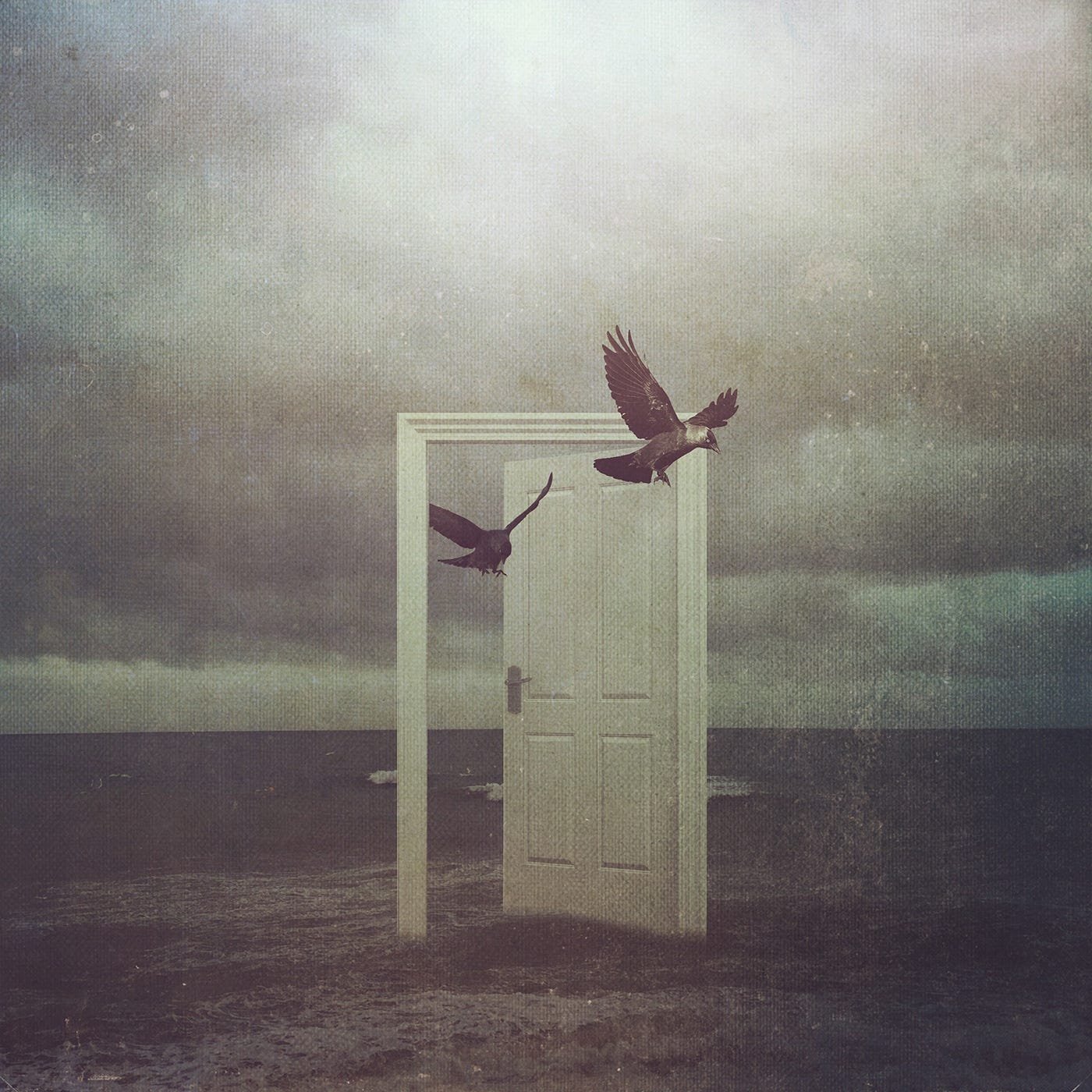
And behind it—inside the shimmer—
I saw my pantry wall where it should not exist,
and a corridor of rippling nothing where paint should be.
The thing looked at me and spoke without sound:
“You saw me. That means you can choose.”
The corridor trembled, hungry with possibility.
So did the sky.
PATH A — Cross the Seam
The first time I crossed over, it was an accident, the way most lifelong hauntings begin:
a wrong turn taken with a confident hand.
I was in my kitchen, midnight-blue under refrigerator light,
cradling a mug that smelled like habit,
when my spoon hit the rim and made a sound too clean for our world.
The air answered with attention.
For half a breath, the room became an outline someone forgot to ink.
Edges softened.
Colors unlearned their names.
The clock blinked twelve times without moving.
Then the pantry door was open.
It shouldn’t have been.
I keep it shut because I like my small, controlled darkness in a predictable place.
But there it was, yawning wide, as if my house had developed a second throat.
Inside, the shelves were still there.
The flour, the rice, the jars of cinnamon I buy in bulk because I tell myself I’ll bake more.
Everything normal—except the back wall.
It had become a corridor of rippling glass.
Not mirror.
Not window.
A vertical slice of water, held up by nothing,
where the pantry paint should’ve been,
where spiders should’ve worked their slow, faithful carpentry.
I leaned in, because curiosity is just fear wearing a better coat.
On the other side, the same pantry existed—almost.
Same shelves.
Same jars.
But the labels were written in a handwriting I recognized as mine,
only tighter, sharper, as if I’d lived with less mercy.
The air smelled different too:
ozone, rain, and something like a dentist’s glove.
I put my fingers through the surface.
Cold.
Dense.
A pressure that tried to count my bones.
When my hand came out the other side, it was still my hand,
but the skin looked… edited,
like a document that had been copy-pasted one too many times.
Fine lines where there shouldn’t be lines.
A faint grid, vanishing when I blinked.
My stomach tightened, and the practical part of me said,
Close the door. Call someone. Pretend you never saw.
The part of me that writes in the margins of my own life said,
Step through.
So I did.
The crossing didn’t hurt.
Just a wrongness in my teeth,
like biting aluminum foil,
and the sense of being “saved” under a new filename.
I stood in my pantry,
in my house,
and the coffee mug was still in my hand.
But the refrigerator hum was different.
Lower.
As if it had swallowed its own complaint.
I walked into the living room.
On the couch sat my partner, Mara,
legs tucked under her like always,
hair piled messy like she never fought it,
reading the same paperback she’d been reading on my side of things.
Except here, she didn’t look up when I entered.
Her eyes were closed.
Her chest didn’t rise.
A faint blue flickered under her skin.
I dropped the mug.
It shattered.
The sound rang once, then corrected itself.
Mara’s eyes snapped open.
And they were mine.
Not literally.
Not matching color.
But the same tired depth,
the same look of someone who’d learned the limits of prayer.
“Don’t scream,” she said, in Mara’s voice.
“It makes it notice you.”
I couldn’t speak.
My throat had turned to cotton.
She swung her feet to the floor, stood, and touched my face.
Her fingers were warm, but the warmth felt manufactured.
“You’re early,” she whispered.
“Usually you don’t slip until the third time.”
“The third time?” I managed.
She nodded toward the pantry,
where the corridor trembled gently, like a muscle holding strain.
“It’s not a doorway,” she said.
“It’s a seam.
And you’re the kind of stitch that frays.”
I wanted to argue.
I wanted to grab Mara and drag her back through with me,
to my side,
to the world where her heartbeat was a daily, boring miracle.
But her hand tightened on my cheek, firm.
“She’s alive there,” she said.
“The Mara you love.
The Mara who still laughs at bad jokes and burns toast and forgets to water the plants.
If you pull me through, you don’t get her.
You get… this.”
She tapped her chest.
The faint blue flicker replied.
“What are you?” I asked.
She smiled with my partner’s mouth and my own grim knowing.
“A version that stayed.
A version that made the wrong choice.”
Behind her, the hallway lights dimmed.
Not from a power surge.
From a presence leaning closer.
The shadows on the ceiling arranged themselves into patterns,
like code trying to become a symbol.
Like a constellation deciding it wanted to be a face.
“Listen,” Mara said.
“You crossed because you made sound in the wrong frequency.
That spoon.
That clean ring.
It’s like whistling into a cave and wondering why something whistles back.”
My hands shook.
I could feel the pantry seam tugging at me,
as if it had placed a soft hook behind my ribs.
“Why is it harder?” I said, because the question tasted prewritten.
Because the universe loves repeating itself.
“It learns,” she said.
“It maps the path you take.
It tightens the passage.
It makes you pay more of yourself to cross.”
“What is it?”
She didn’t answer that directly.
Instead, she said,
“On my third crossing, I left my laugh behind.
On my fourth, I couldn’t taste cinnamon anymore.
On my fifth, my dreams stopped having faces.”
She lifted her sleeve.
Under her skin, the blue flicker now stuttered, like a dying pixel.
“And on my last,” she whispered,
“I felt it put a hand in my skull.
Not to hurt.
To hold.
To keep me where I could be indexed.”
The room chilled.
In the pantry, the seam rippled harder.
I backed toward it, because my body wanted home the way lungs want air,
even when air tastes like smoke.
Mara followed, her steps quiet, careful.
She looked into the corridor and then back at me.
“You can’t keep doing it,” she said.
“You’ll tear.
Or it will.
Either way, you won’t be you in the end.
You’ll be a file.
A category.
A name under glass.”
I stared at the corridor.
On my side of it, my pantry light glowed soft.
I could almost pretend the world was stable.
“I can’t leave you,” I said.
I meant Mara.
I meant this version.
I meant every possible grief.
“You already did,” she said gently.
“This isn’t about saving me.
This is about choosing what kind of loss you can live with.”
The presence pressed closer.
A low vibration ran through the walls.
Mara’s voice tightened.
“Go,” she said.
“Before it realizes you’re here.”
I stepped into the seam.
This time it hurt.
Not in flesh, but in memory.
As I crossed, I felt something snag:
a childhood smell,
the exact pitch of my mother’s voice,
the way my own name feels in my chest.
The corridor tightened like a fist.
I stumbled into my pantry, my world,
gasping as if I’d been underwater.
Behind me, the seam shuddered, smaller now,
as if it had taken a bite.
I slammed the pantry door and latched it.
In the living room, my Mara called out,
“Hey—did you drop something?”
Her voice was warm.
Real.
So painfully ordinary it almost made me sob.
I walked to her like a person returning from war,
trying to fit my grief into a smile.
“I’m okay,” I lied.
“I just… got clumsy.”
She laughed.
A little, easy sound.
The sound I’d just been told could be stolen.
That night, I didn’t sleep.
I sat at the kitchen table,
listening for the clean ring of a spoon,
afraid of silence,
afraid of sound.
In the pantry, behind the door,
something softly tapped once,
as if checking a lock.
Then twice.
Then, in the thin space between taps,
I heard a page turn.
And I realized, with the cold clarity of a telescope pointed too far,
that staying meant guarding the seam forever,
and that forever is just a word we use
until the universe decides to correct us.
PATH B — Refuse the Seam,
I shut the door.
Not gently. Not ceremonially. No final look over the shoulder like I’m in a movie and the audience needs a last shot of my face. I shut it the way you shut a refrigerator you know you didn’t close all the way: fast, annoyed, with a little fear tucked under the motion.
The latch clicks.
The sound is wrong.
It’s the same click as always, but it lands with a second tone underneath it—like something far away echoed my decision in a language made of hinges and hunger.
The hallway light flickers once, steadying itself like it’s embarrassed for reacting. My apartment smells the same: dish soap, old books, the faint metallic tang of the radiator. My body keeps waiting for the pressure-drop, for the air to thin, for the second world to tug me by the teeth.
Nothing.
That’s the first lie.
The second lie is the relief.
Because “staying” sounds like safety. Like keeping your hands on the wheel. Like choosing the world you were born in, the one with familiar cracks and predictable weather. Staying is what normal people do.
Except I’m not normal anymore.
Not after you see a parallel universe watch you back.
I walk past the mirror in the entryway and stop because my reflection doesn’t stop with me.
It’s a fraction late—so small a delay you could blame it on cheap glass. But it keeps breathing after I hold my breath. Its eyes track my face like it’s learning the math of it.
I lean closer.
My reflection leans closer too, but not to match me—more like it wants to smell me through the barrier. Its pupils look too dark, too deep, like somebody poured ink into them and called it vision.
“Not tonight,” I whisper, because talking to your own reflection is either the beginning of madness or the last shred of etiquette before it starts.
The reflection smiles.
I do not.
I back away and keep moving. I don’t look again.
In the kitchen, I fill the kettle. The ritual matters. Cozy isn’t something I’m good at, but I understand routine. Routine is a fence humans build out of repetition and call it peace.
The kettle begins to sing.
The note bends halfway through.
Not enough to be obvious, just enough to make my molars ache like they’re remembering a frequency they’ve never heard. The steam curls up in a shape that isn’t random, and for a moment it looks like a hand opening.
I blink and it’s steam again.
I make tea anyway.
I sit at the table with the mug between my palms and feel the warmth travel into me. The heat is real. The ceramic is real. The small domestic comfort is real.
And then my phone buzzes.
Unknown number.
No caller ID, no spam warning, no name—just a blank line, like the device can’t decide whether this message is allowed to exist.
YOU CHOSE WRONG.
I stare at it until the letters blur.
Then, like my phone is embarrassed by its own honesty, the message disappears. The notification clears itself. I scroll. Nothing.
I laugh, and it’s a thin sound. A sound that belongs to someone in a room where the walls have started leaning.
The third lie is that I think I can out-stubborn this.
I get up and walk to the window. Outside, the street is quiet. The same old row of porch lights. The same old cars sleeping at the curb. The same old sky, bruise-blue and indifferent.
Except the stars are… off.
Not gone. Not dim. Just wrong, like someone rearranged them a few degrees and hoped nobody would notice. Constellations that used to feel like fixed stories now look like letters from an alphabet I can’t read.
I press my forehead to the glass. Cold.
In the reflection of the window, my own eyes look too bright.
That’s when I feel it.
A tug.
Not at my skin—under it. A gentle pull behind my ribs, like the world is testing whether my organs are willing to come loose.
I grip the windowsill until my knuckles pale.
“Stop,” I say out loud, to the room, to the air, to the thing that has been practicing my name in its mouth.
The tug eases.
Then returns, patient.
It’s not dragging me. It’s inviting me.
I don’t know which is worse.
I turn away from the window and the apartment seems… flatter. Like the depth got turned down. Like somebody sanded the corners off reality. My bookshelf looks too aligned. The photos on my fridge look staged. Even the shadow under the couch has a too-clean edge, like it was cut out and placed there.
My eyes keep hunting for the seam.
Once you know a seam exists, your whole life becomes a thumb running along it.
I try to distract myself with normal things. Dishes. Laundry. A dumb sitcom I half hate. I laugh at the jokes a beat late because part of my brain is listening for the wrong note beneath the laugh track.
And then the doorbell rings.
Nobody rings my doorbell.
My friends text. Delivery people leave packages. Neighbors avoid eye contact like it’s a contagious illness.
The doorbell rings again.
Not frantic. Not urgent. Just polite.
I stand there, frozen, hand hovering over the arm of the couch like I need to hold on to furniture to remain a person. My mouth is dry. The air tastes faintly of pennies.
The doorbell rings a third time.
I walk to the door. Slowly. Like if I move fast the universe will think I’m eager.
Through the peephole, I see the hallway empty.
No one. Nothing. Just the dull carpet and the flickering ceiling light.
The doorbell rings from inside the apartment.
Not behind me.
Within me.
My stomach drops like it found a trapdoor.
I step back and almost trip over my own feet. The light above the kitchen sink flickers in a soft rhythm—blink… blink… blink—like an eye trying to get comfortable.
My reflection in the dark TV screen stands up even though I’m standing still.
It’s not a perfect copy anymore.
Its shoulders are a little too narrow. Its smile is a little too wide. It holds its head like it’s listening to music I can’t hear.
And then it speaks without moving its mouth.
Not with sound.
With pressure.
A thought that isn’t mine slides into the center of my skull like a coin into a slot.
STAYING DOESN’T MEAN I LEAVE YOU ALONE.
My throat tightens. My hands shake. The mug on the coffee table rattles against the wood.
I think about the other world—the door, the fog-light air, the not-quite-same. I think about the way the crossing got harder each time, like my body was turning into a key that only fits one lock.
But I stayed.
I stayed, and apparently that was permission.
The TV screen reflection lifts a hand.
My body lifts its hand too.
Not because I chose to.
Because something else is learning the controls.
I slam my raised hand down against my thigh like I’m punishing a misbehaving limb. Pain blooms. Real pain. That’s good. Pain means I’m still here.
But the pain doesn’t chase the foreignness out. The foreignness just watches the pain like it’s interesting data.
I stumble into the bathroom and turn on every light. White glare. Tiles. Mirror.
In the mirror, I’m me—except the edges of me don’t line up right. Like somebody traced my outline and then shifted it half an inch. My eyes keep trying to focus on my own face and sliding off.
Behind me, the shower curtain ripples as if a draft moved through.
There is no draft.
The air in the bathroom is thick, humid without reason, like breath has been exhaled here repeatedly for a long time.
I watch the mirror.
My reflection watches back.
And then, slowly, my reflection raises its hand and places its palm against the glass.
I do not move.
Its fingers splay, and the skin beneath them darkens as if bruising from pressure. The glass does not fog. The glass does not smudge.
It softens.
Not melting—yielding.
Like the barrier was always there to make humans feel better, not to stop anything.
My reflection leans closer and the space between us looks deep—impossibly deep—like the mirror contains an ocean and my face is the surface.
YOU CAN KEEP YOUR WORLD, the pressure-thought says. I ONLY NEED ACCESS.
The mirror warps outward, bulging toward me. The light overhead stutters.
My heart is loud. My own pulse feels like a knock on a door I can’t find.
I grab my toothbrush off the sink—because it’s the first thing my hand lands on—and I laugh again, because what am I going to do, stab a cosmic phenomenon with mint plastic?
The laugh becomes a choke.
The mirror bulges more.
On the other side, behind my reflection, something moves in the depth: a slow rotation, like a pupil turning inside a skull the size of a sky.
My reflection’s mouth finally moves.
It smiles wider.
It whispers with my own voice, perfectly copied, perfectly wrong:
“Thank you for staying.”
The mirror gives.
The air changes.
Not colder. Not warmer. Just… thinner, like the atmosphere remembered it doesn’t owe me comfort. A smell seeps into the bathroom—wet stone, deep water, the coppery scent of a storm that doesn’t belong to weather.
The hand comes through.
Not clawed. Not monstrous. Just a hand at first—human-shaped, wearing my skin like a glove it hasn’t earned. But the way it moves is not human.
It moves like a question.
It moves like an algorithm trying out a new interface.
I step back and hit the doorframe. My shoulder throbs. My feet want to run, but there’s nowhere in this apartment that doesn’t have reflections. Windows. Screens. Polished metal. Dark glass.
Every surface is a potential mouth.
The hand grips the edge of the mirror and pulls.
Something begins to emerge behind it—me, but not me. A version cut from the same template, scaled in some places, stretched in others. The same face, but the eyes are too calm, too patient, too certain.
It’s not here to kill me.
That would be simple.
It’s here to continue.
A maintenance worker doesn’t destroy the system.
A maintenance worker fixes what doesn’t fit.
And I don’t fit anymore.
My own body shudders, and for a second I feel my thoughts reorder themselves—memories shifting like files being renamed. The names of my friends blur. The layout of my childhood home feels like a dream. My own middle name goes blank.
My life starts to look like something that could be deleted without anyone noticing.
I do the only thing that feels like mine.
I look at the mirror-version of me, halfway through the glass, and I speak first.
Not a plea.
Not a scream.
A command, like you can bully the universe if you say it with enough conviction.
“You don’t get to wear me.”
The thing pauses.
Its smile falters—not because it’s offended.
Because it’s curious.
Curiosity is the most terrifying emotion a god can have.
WHY NOT? it asks, not in words, but in a sensation: the itch in the back of your throat when you’re about to confess something you promised you wouldn’t.
Because then I have to admit the truth.
Because I stayed for comfort. Because I stayed for safety. Because I stayed because the other world scared me.
And now my own world is the one that’s opening its mouth.
I swallow, and my throat feels like it’s full of static.
“I’m not a door,” I say, voice shaking but loud.
The mirror ripples.
The thing’s fingers tighten.
EVERYTHING IS A DOOR, it answers, gently, as if teaching a child.
And then it steps forward—
and my bathroom light blinks—
not like a power flicker.
Like a lid closing.
And in that darkness, I understand the last rule of staying:
You can refuse to cross into the other world.
But you can’t stop the other world from crossing into you.