

SEAM-EATER Part II
(A Loom-and-D’Veen Convergence Tale — Annihilation Epoch / ~400 years after The Loom and the Maw*)*

Before the story
SEAM-EATER continues.
Part I was the tear—proof in the catacombs, a strip of world-fabric stolen clean out of the Loom’s tapestry, and the first step into a realm that shouldn’t know our names.
Part II is what happens after the crossing: D’veen’s silence starts acting like a presence, not an absence. Varrus and the Thread Bearers follow disturbances in pattern like blood in water. Finton, meanwhile, realizes the “outsider” isn’t just pressing at the veil—it’s already teaching the world how to speak back.
If you’re new here, you can start now. here is part I.

don’t touch the seam.
Part II begins below.
PART 2 — THE ANNIHILATION EPOCH HAS NEW TEETH
V. ASH DOESN’T FALL HERE—IT LISTENS
Varrus learned quickly
that D’veen’s silence was not empty.
It was occupied.
The wind moved wrong,
not in direction—
in intention.
It didn’t pass through the ruined streets
like weather.
It skimmed them
like fingertips over scar tissue,
testing which wounds still flinched.
The Loom-thread around Varrus’ wrist
pulled faintly as his Order advanced,
a constant reminder that home still existed
somewhere behind the seam—
and also that the seam
did not like being reminded.
The Thread Bearers moved in a staggered line,
mantles pale against soot-dark stone,
each one carrying a different tool of the Order:
A needle made from a saint’s rib.
A spool of light-thread sealed in glass.
A blade etched with stitch-signs
that never cut flesh the same way twice.
Varrus carried none of those.
He carried the Loom’s permission in his spine
and the burden of being the one
whose mistakes became doctrine.
They followed signs the way animals follow scent—
not footprints,
not broken branches—
but disturbances in pattern.
A doorframe leaning at an angle
that made the air around it itch.
A patch of road where pebbles arranged themselves
into a spiral when no one watched.
A dead crow—impossible, since there were no birds—
laid out like a symbol.
Each clue felt less like evidence
and more like a lure
left by something that understood curiosity
was just hunger wearing a better coat.
One of the Thread Bearers, Jessa,
paused beside a collapsed market stall.
“Head Thread,” she murmured.
Varrus stopped.
She pointed at the stall’s wood slats.
Scratched into them—fresh—
were shallow grooves.
Not words.
Not exactly.
A series of small, repeating cuts
that resembled a stitch pattern
gone wrong.
Varrus bent close.
His stomach tightened.
This wasn’t Thread Bearer script.
This was someone imitating it
without knowing what it meant.
Like a child drawing a noose
because it likes the shape of circles.
“They’re learning,” Jessa whispered.
Varrus straightened.
“Yes,” he said.
He looked down the street.
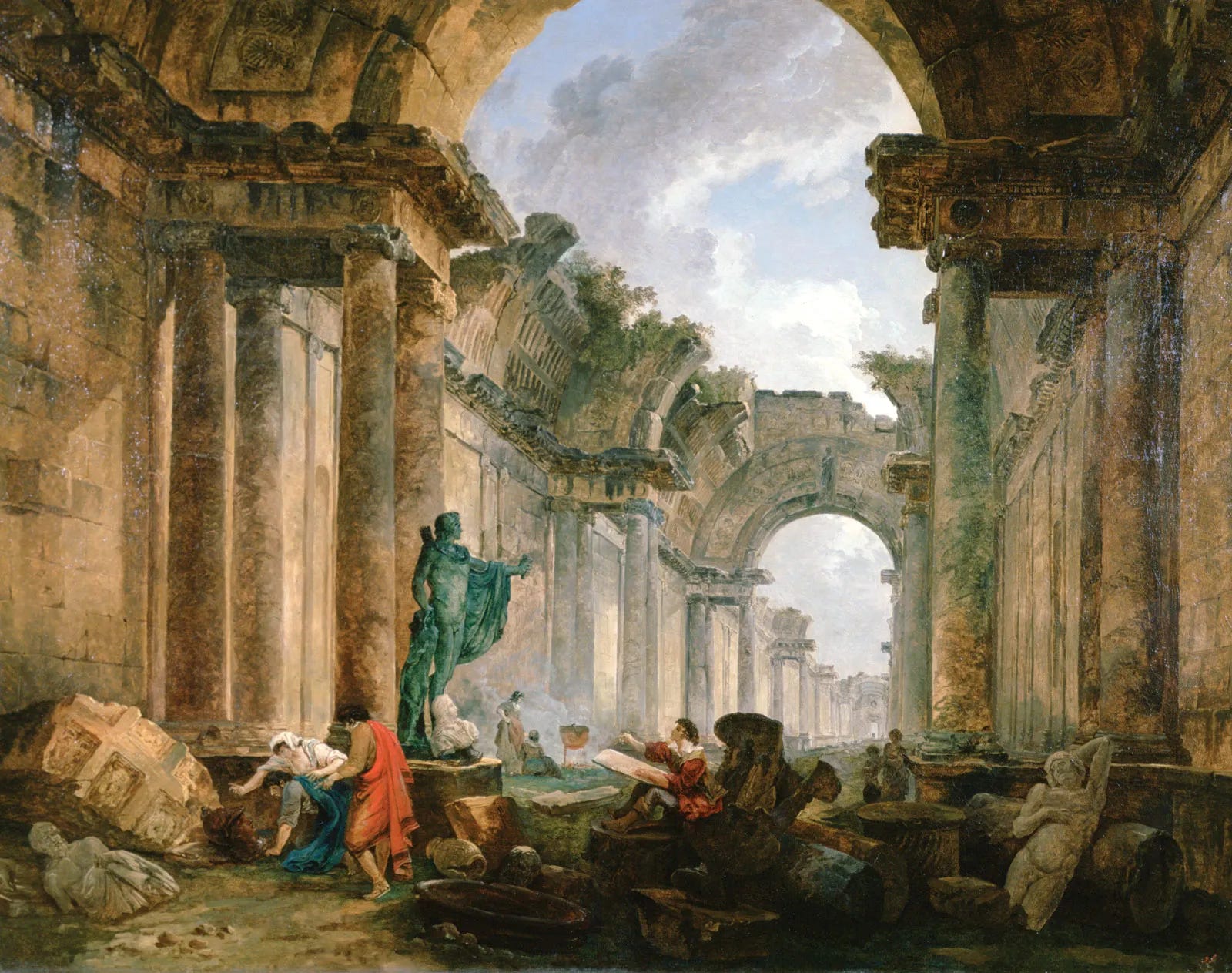
Farther ahead, the ruined city opened into a plaza
where a statue lay broken on its side—
some Titan-era hero, maybe,
or some human king who once thought
stone could protect him from history.
The statue’s face had been chiseled away.
Not vandalized.
Removed with deliberate care
as if someone didn’t want the world
to remember who it had once prayed to.
Varrus felt the Loom hum sideways again.
He lifted his hand
and drew a small stitch-sign in the air,
not binding,
not sealing—
listening.
The air responded with a faint shimmer,
like a spiderweb catching light
only when the angle is perfect.
He followed that shimmer.
It led to the base of the toppled statue.
And there—beneath the stone’s shadow—
a thin line in the air
wavered.
A seam.
Not open.
Not yet.
But stressed.
Like fabric
right before it rips.
Varrus crouched.
The seam smelled like tallow
and old spite.
He didn’t touch it.
He did not offer his skin to foreign law.
Instead he pressed two fingers to his wrist
and felt the Loom-thread tug.
The tug wasn’t toward home.
It was toward down.
Toward depth.
Toward a place D’veen had already cut open
and tried very hard to forget.
One of the younger Bearers swallowed.
“I can feel it,” he whispered.
“It’s like… like the air has a pulse.”
Varrus nodded once.
“That’s because it does,” he said.
“This realm is wounded,
and wounds beat.”
He rose.
“Move,” he ordered,
and the Order followed.
As they left the plaza,
Varrus glanced back.
For the briefest moment
the seam beneath the statue
seemed to widen—
not with force—
with interest.
As if something behind reality
had noticed him noticing it.
The Loom-thread around his wrist
tightened like a warning.
VI. FINTON MERRYBROOK LEARNS A NEW KIND OF WRONG
Finton did not sleep after the cottage.
He sat in a chair that wasn’t his
and listened to the painting breathe.
That is what it did.
It breathed—
in and out—
so softly a sane man would call it imagination
and move on.
Finton had outlived sane men.
He placed his listening stone on the table.
It warmed and cooled in pulses,
a heartbeat that didn’t match his own.
The silhouette—
the not-quite-person—
stood near the easel,
its edges wavering.
“It’s getting louder,” she whispered.
Finton watched the canvas.
The violet sky inside it
darkened by fractions,
as if an eclipse was happening
in a place that wasn’t a place.
One of the distant stars blinked again.
Not like a star.
Like a lid.
Finton exhaled.
“I need names,” he said.
The silhouette’s head tilted.
“Names are dangerous,” she replied.
“Everything is dangerous,” Finton said.
“But I need the right kind of dangerous.”
He reached into his satchel
and drew out a folded paper—
a list of taverns, crossroads,
people who still owed him favors.
He hated favors.
They were threads around your throat.
But he hated ignorance more.
“Order of the Pawn,” he muttered.
The words tasted like rusted courage.
He had built the Order
because he had watched too many heroes die
for causes that didn’t deserve them.
Pawns were different.
Pawns didn’t need glory.
They needed direction.
They needed a board
and someone willing to admit
the game was rigged
and play anyway.
Finton stood.
He did not look at the silhouette.
He looked at the painting.
“If something outside D’veen is pressing its face to our veil,” he said,
“then either it’s lost—
or it’s hungry.”
The silhouette’s voice cracked.
“It’s hungry.”
Finton nodded.
“Then we do what we always do,” he whispered.
He rolled his shoulders.
His age creaked in him like old floorboards.
“We find the door,” he said,
“and we decide whether we can afford to slam it.”
He stepped toward the canvas.
The air in front of it prickled.
The listening stone on the table
vibrated hard enough to rattle.
Finton didn’t touch the painting.
He didn’t need to.
He leaned close,
as if listening at a wall.
And he heard it.
Not words.
Not sound.
A pressure in the skull.
A sensation of being looked at
by something that didn’t have eyes
because it didn’t need them.
Finton’s lips parted.
He whispered the first name
that rose from the sensation—
not because it was accurate,
but because it was the closest shape
his mind could hold without breaking.
“Outsider.”
The air shivered, pleased.
Finton stiffened.
The shiver felt like agreement.
That scared him more than hostility.
Because hostility meant boundaries.
Agreement meant entry.
He stepped back.
He grabbed his satchel.
He did not take the listening stone—
he left it on the table,
still pulsing,
still listening—
because he had a sudden, sharp thought:
If it learns to listen back,
then anything that listens becomes a mouth.
He left the cottage quickly.
Outside, the shattered moon
hung above the treeline
like a broken promise.
The wind carried rot.
Finton walked toward the nearest road-marker
where he knew, if the world still behaved,
a runner from his Order would sometimes wait.
Sometimes.
If the runner hadn’t been eaten by the epoch.
If the epoch hadn’t decided
to repurpose him.
He found the marker.
A stone pillar with faded runes.
No runner.
But something else.
A strip of red cloth
tied around the pillar’s middle
like a ribbon on a grave.
Finton’s chest tightened.
He untied it carefully.
The cloth was damp.
Not with rain.
With sweat.
Human sweat.
And inside the knot
was a small object—
a pawn token, carved from bone.
Finton recognized it.
One of his.
A message.
He flipped the token.
On the underside, scratched in hurried strokes:
AVONDALE. ROT STIRS. SOMETHING ELSE TOO.
EYES IN THE SKY THAT AREN’T OURS.
KAZRA’S DEEP BREATHES.
Finton stared at the last line.
Kazra’s Deep breathes.
He swore softly.
Of course it did.
Of course the prison chose now
to remember it was alive.
He folded the cloth and token into his satchel.
Then he set off toward Avondale.
Not because Avondale was safe.
Because it was a place where danger had names,
and named danger was a kind of comfort.
VII. THE CULTISTS MAKE A MAP OUT OF PAIN
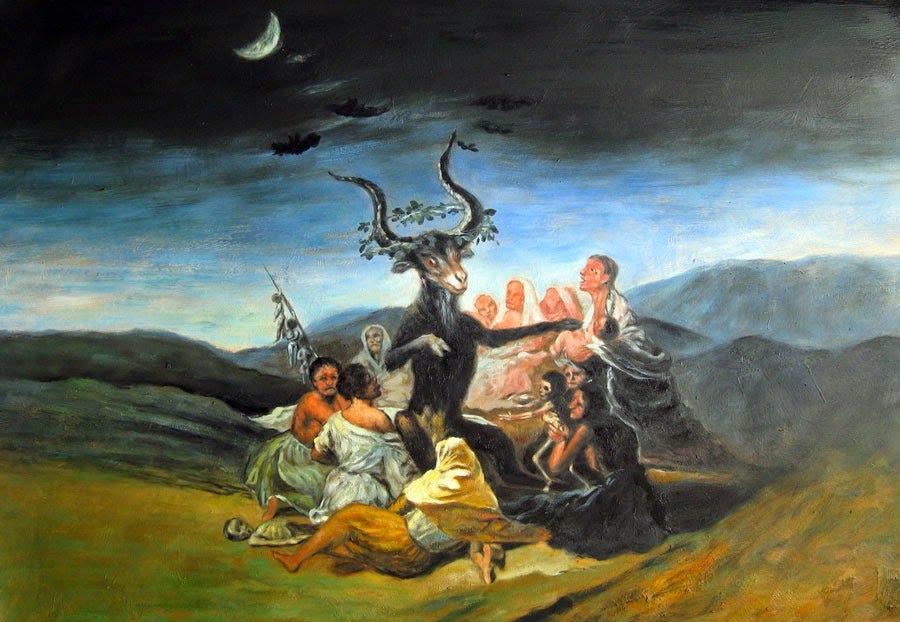
The cult leader—Smile-Scar—
stood on a ridge above a dead orchard
and watched D’veen’s horizon tremble.
Behind her, the cultists moved quietly,
hands busy with their black thread spool.
They had learned quickly
that D’veen’s fabric resisted.
Not like the Loom’s tapestry resisted—
the Loom resisted with authority.
D’veen resisted with exhaustion.
Like a man too tired to fight
but still too proud to kneel.
The leader liked that.
Exhaustion was soft.
Soft things tore.
She held up her palm.
The others stopped.
In the distance,
a ravine split the earth
like a fresh cut.
Cold air rose from it in steady breaths.
Kazra’s Deep.
They had heard the name in whispers
from ruined villages,
from madmen at crossroads,
from paintings that cried when you stared too long.
A prison.
A place where Titans had tried
to solve their mistakes
by burying them.
The leader smiled.
Burying mistakes
was how you fed them.
She turned to her youngest cultist—
the one who still looked nervous,
still human enough
to feel the shape of consequences.
“Do you feel it?” she asked.
He swallowed.
“Yes,” he whispered.
“What does it feel like?”
He hesitated.
Then: “Like… like something sleeping
with its mouth open.”
The leader nodded, pleased.
“Good,” she said.
She pulled the black thread spool from her satchel
and unwound a length.
The thread shimmered wetly
in the shattered moonlight,
drinking it.
“This realm is already full of hunger,” she murmured.
“We don’t need to bring our god all at once.”
She looked toward the ravine.
“We just need to teach the hunger
the shape of Azhal’Ruun’s name.”
She wrapped the black thread around her wrist
and cut it with her teeth.
The thread did not snap clean.
It stretched, elastic, alive.
Her cultists watched her, reverent.
Smile-Scar raised her hands.
“Draw the address,” she whispered.
And the cultists began to work.
They drove stakes into the soil
around the ravine’s lip.
They looped black thread between them
in spirals and ribs,
imitating the Loom’s sacred curves
and turning them inside out.
They pressed tallow candles into the earth,
lit them,
and let the smoke rise thick and greasy.
The smoke did not drift away.
It clung to the thread-lines
as if attracted.
As if the thread was teaching the air
where to gather.
As the pattern formed,
the ravine’s breath changed.
It grew warmer.
Not comforting.
Alive.
Smile-Scar closed her eyes.
She listened.
And she heard something stir beneath.
Not the Slumbering Terror itself—
not yet—
but the attention of it.
A slow turning of something vast
toward the new smell in its cage.
She smiled wider.
“Hello,” she whispered into the ravine.
Her voice echoed back wrong.
Not delayed.
Returned altered.
The ravine answered in a layered chorus
made of stone and sleep:
“HELLO.”
The cultists shuddered with awe.
Smile-Scar opened her eyes
and looked up at the shattered moon.
“Soon,” she murmured.
Not to her cult.
To the god behind her thoughts.
“Soon you’ll have a realm
that doesn’t know how to refuse you.”
VIII. VARRUS THREADBORNE FINDS THE FIRST ANCHOR

The ravine’s wind hit Varrus
long before the ravine appeared.
It carried a stink
that made his teeth ache.
Not Rot.
Not exactly.
Rot was D’veen’s disease.
This was an infection with intent.
A flavor of malice
laid over decay like oil over water.
The Thread Bearers approached the ravine cautiously,
their pale mantles catching moon-shards.
At the edge, they stopped.
Because they saw the pattern.
Black thread strung between stakes.
Tallow smoke hanging in place
like a held breath.
Spirals carved into the soil
as if someone had used a knife
to teach the earth
how to remember a wound.
Varrus crouched near one stake.
He did not touch the black thread.
He didn’t need to.
He could feel it tugging
at the air around it.
As if it was sewing the ravine to the sky.
One of his Bearers whispered,
“Blasphemy.”
“Yes,” Varrus said.
He stood.
He looked down into the ravine.
The darkness below was too deep.
Not because light couldn’t reach.
Because the darkness ate it.
Varrus felt something down there
press against the underside of the world
in slow, patient curiosity.
He remembered the cult leader’s warning,
the scraps of doctrine about Azhal’Ruun:
He does not arrive as a person.
He arrives as a condition.
A rule change.
A law that says:
Suffering is not a byproduct.
Suffering is the point.
Varrus looked at the pattern again.
This wasn’t a summoning yet.
It was an anchor.
A place for malice to tie its rope
before it started pulling.
The Loom-thread around Varrus’ wrist
tightened sharply.
A warning.
He realized, in that instant,
what the cultists were doing:
They weren’t trying to rip D’veen open
with brute force.
They were trying to convince D’veen
to rip itself open willingly.
To make the prison participate.
To make the wound confess
it had always wanted to be a mouth.
Varrus raised his hands.
The Thread Bearers behind him formed a circle,
silent, disciplined.
He drew a stitch-sign in the air—
not binding.
Not sealing.
A severing curve.
The Loom answered with a cold, precise hum
that made the black thread lines vibrate.
The tallow smoke trembled.
Then—
it laughed.
A soft crackle, like fat on flame.
Varrus’ skin prickled.
The laugh wasn’t from any throat.
It was from the pattern itself.
As if the anchor
was already learning joy.
One of the Thread Bearers faltered.
“Head Thread—”
Varrus cut him off.
“Hold,” he said.
He stepped into the pattern ring.
The black thread lines tightened,
reacting to his presence.
They wanted to wrap him.
They wanted to measure him.
They wanted to learn how Loom-thread felt
so they could imitate it.
Varrus moved carefully,
keeping his gaze down,
refusing to look into the ravine.
He reached the nearest stake
and placed two fingers an inch from the thread,
letting the Loom’s hum fill his bones.
Then he did something that felt wrong
in a foreign realm:
He commanded reality.
“Unweave,” he whispered.
The Loom’s severing curve flared.
A line of pale light
sliced through the black thread.
The thread snapped—
but not like fiber.
Like tendon.
It recoiled with a wet twitch
and the severed ends
tried to crawl toward each other,
trying to stitch themselves back.
Varrus moved fast.
He drew the severing curve again,
cutting another segment.
The Thread Bearers behind him followed suit,
their hands making the same gesture
with the same cold precision.
Black thread lines snapped one by one.
The pattern trembled.
The tallow smoke bucked.
And then—
from below—
a sound rose.
A deep, slow inhale.
The ravine’s breath.
But altered.
As if something sleeping beneath
had smelled blood.
Varrus froze.
He felt a pressure from below,
a vast attention turning.
Not Azhal’Ruun’s.
Something older to this realm.
Something Titan-bound.
Something that did not appreciate
its prison being redecorated.
The air around the ravine thickened.
Stones at the edge
vibrated faintly.
Jessa whispered, voice shaking,
“What did we wake?”
Varrus’ mouth went dry.
“We didn’t wake it,” he said.
He stared at the severed black thread ends
still trying to crawl.
“We reminded it.”
The ravine exhaled.
And the exhale carried a word
no human throat could shape.
A sound like rock grinding on bone.
The Thread Bearers flinched.
Varrus didn’t.
He felt the Loom-thread around his wrist
pull hard—
not toward home.
Toward away.
As if the Loom itself
was trying to drag him back from the edge
by force.
Varrus swallowed.
If the Loom was warning him—
then whatever was stirring beneath Kazra’s Deep
was not just a local threat.
It was a second god-mouth.
A second hunger.
And the cultists had chosen it
as their altar.
Varrus stepped backward out of the pattern ring.
He raised his hand.
“Fall back,” he ordered.
The Thread Bearers retreated,
slowly,
carefully,
like backing away from a sleeping beast
whose eyelid has begun to twitch.
As they withdrew, Varrus’ gaze flicked once,
against his will,
toward the ravine’s depths.
For a heartbeat
he saw something down there—
not a creature—
a shape of absence
wrapped around a pulse of ancient will.
It wasn’t awake.
Not fully.
But it was aware.
And it was hungry.
Varrus looked away instantly.
Too late.
His mind tingled
as if something had brushed it.
A question forming not in words
but in appetite:
What are you?
Varrus clenched his jaw.
He tightened his grip on his own thoughts.
He would not answer by existing too loudly.
He led his Order away from the ravine.
But he knew—
with a cold certainty—
that the cultists had succeeded in one thing:
They had gotten the prison’s attention.
And attention, in cosmic terms,
was half of a door.
IX. A BOARD BEGINS TO FORM
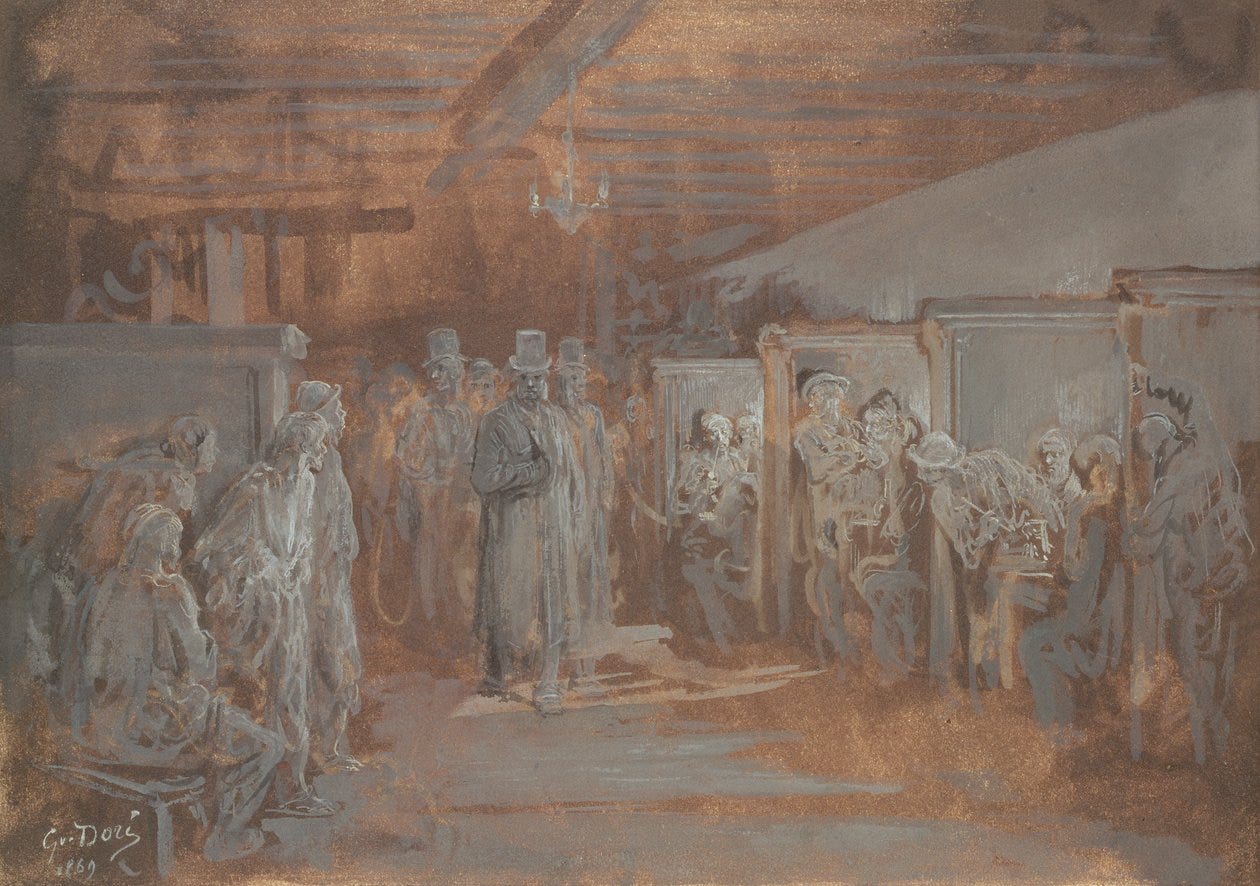
Finton reached Avondale
at the edge of dawn
when the sky couldn’t decide
what color it deserved.
The forest around Avondale
was thinner than it should have been,
as if the trees had started dying
in self-defense.
He found one of his taverns
still standing.
The sign swung in the wind
like a pendulum measuring doom.
Inside, the air was warm—
a miracle.
People sat in corners,
speaking in low voices
as if volume could attract gods.
When Finton entered,
heads turned.
Not with hope.
With recognition.
Finton Merrybrook meant trouble
in the way thunder means trouble.
A woman approached him,
cloak stained with travel,
eyes sharp enough to cut rope.
A Pawn.
One of his.
“Finton,” she said.
He nodded.
“Tell me what you’ve seen,” he replied.
She didn’t waste time.
“Rot pockets,” she said.
“More than before.
And the moon… it’s been staring.”
Finton’s stomach tightened.
“And Kazra’s Deep?” he asked.
Her expression flickered.
“A runner didn’t come back,” she said.
“One came back wrong.”
Finton’s voice went very quiet.
“Wrong how?”
She swallowed.
“He kept repeating a phrase,” she said.
“Like a prayer.”
Finton’s skin prickled.
“What phrase?”
She hesitated.
Then, reluctantly:
“‘Hold the thread.’”
Finton went still.
That wasn’t D’veen language.
Not any oath he’d written.
Not any prayer his realm had grown.
Hold the thread.
It sounded like a warning
from somewhere else.
From another set of hands.
Finton’s gaze hardened.
“Where is the runner now?” he asked.
“Locked in the cellar,” she said.
“He tried to bite someone.”
Finton nodded once.
“Show me,” he said.
He followed her down into the tavern’s lower rooms
where the air smelled of damp wood and fear.
At the end of the corridor
a heavy door sat reinforced with iron bands.
Behind it, a voice murmured
in a layered cadence
that did not belong to one throat.
“Hold the thread,” it whispered.
“Hold the thread.
Hold the thread—”
Finton’s hand hovered near the latch.
He didn’t open it.
Not yet.
He leaned close.
“What did you see?” he asked through the door.
The voice paused.
Then, softly:
“A seam.”
Finton’s breath caught.
“A seam in what?” he demanded.
The voice on the other side
laughed wetly.
“In everything,” it said.
Finton stepped back.
His mind reached for the painting again,
for the foreign hum,
for the star that blinked like an eye.
He realized then—fully—
that whatever was pressing at D’veen’s veil
was no longer a distant pressure.
It was already sending messages through people.
Already writing phrases into mouths.
Already teaching locals
how to speak its language.
Finton looked at his Pawn.
“We’re moving,” he said.
“To where?” she asked.
Finton’s eyes lifted
toward the direction of Kazra’s Deep.
His jaw set.
“Toward the mouth,” he said.
“Before it learns how to say our names.”
To be continued. . .
I am coming here to say I am beyond excited to start reading this but I’m waiting till after FFF so it can have my full attention!